A historical comparison between Nazi Germany's resistance movements and Iran's opposition today, examining how authoritarian regimes brand patriots as traitors.
By Khodanoor Afkari (Penname)
When “Treason” Becomes a Political Label
Authoritarian regimes often survive by redefining loyalty. In such systems, for a long period of time, loyalty to the nation becomes indistinguishable from loyalty to the ruling regime. Opposition is not merely disagreement; it is branded as betrayal. This logic was central to Nazi Germany, where opponents of Adolf Hitler and the Nazi regime were routinely labeled Volksverräter (“traitors to the people”) and prosecuted for “high treason” (Hochverrat) or “undermining military morale” and “sedition and defeatism” (Wehrkraftzersetzung).[1],[2]
Yet many of those condemned as traitors are now remembered as among the most courageous figures in German and world history.
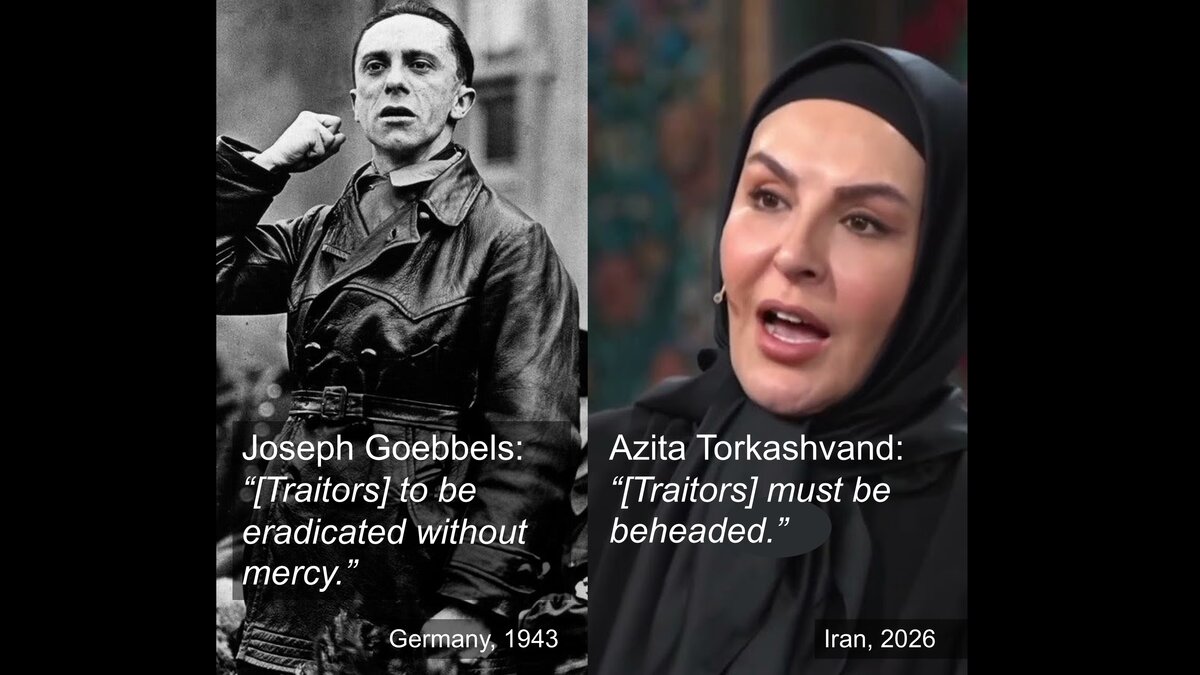
Similar dilemmas appear in modern struggles against authoritarian rule, including in Iran today, where political opposition is often framed by proponents and sympathizers of the Islamic Republic regime (whether hardliner or “moderate”) as betrayal of the nation, especially when it seeks external pressure or support for change. A famous equivalent term that the regime itself uses to prosecute its opponents is Moharebeh (war against Islamic rule), reminiscent of labels the Nazi regime used against opponents.[3] Recently, a pro-regime actress (Azita Torkashvand) stated that “those who sell their nation must be beheaded,” referring to the opponents of the regime;[4] a statement that is very similar to the statements of the Nazi propaganda minister, Joseph Goebbels.
“Those who sell their own tribe and nation must be beheaded. The subject of motherland, defending motherland and the people is something that cannot be negotiated for.”
— Azita Torkashvand (pro-regime actress in Iran), 2026 [4]
“The enemy within is just as dangerous as the enemy from without. Against saboteurs, defeatists, and shirkers, there is only one punishment in total war: death. The people demand that traitors to the people (Volksverräter) be eradicated without mercy.”
— Joseph Goebbels (Reich Minister of Propaganda), 1943 [5]
The German experience does not provide direct answers in all cases, but it offers a historical lens for understanding how regimes define “patriotism” and “treason.”
The White Rose: Moral Resistance
The White Rose was a student resistance group centered at the University of Munich, led by Hans Scholl, Sophie Scholl, and Christoph Probst.[6] Between 1942 and 1943, they distributed anti-Nazi leaflets calling for moral resistance and opposition to Hitler’s dictatorship.
Their political awakening was deeply shaped by World War II’s turning point, especially the Battle of Stalingrad (1942–43), one of the deadliest battles in history, resulting in catastrophic German losses in the order of hundreds of thousands.[7] About 91,000 German soldiers surrendered but later perished due to starvation, freezing, and disease. The White Rose explicitly referenced Stalingrad in their final leaflet, describing it as evidence of the regime’s criminal destruction of human life. For Iranians battling the regime, the massacre of tens of thousands of protesters in January 2026 could count as a parallel to Stalingrad in terms of the severity of human losses and as the worst bloodshed since the establishment of the Islamic Republic regime.[8],[9]
The White Rose concluded that National Socialism could not be reformed internally. As the United States Holocaust Memorial Museum notes, they understood that only military force could end Nazi domination, even while their own role remained strictly nonviolent resistance.[10] History suggests that totalitarian regimes rarely distinguish between armed resistance and effective nonviolent opposition; once both are perceived as existential threats, they are often punished with equal severity.
In February 1943, Hans and Sophie Scholl were arrested while distributing leaflets at Ludwig Maximilian University of Munich. They, along with Christoph Probst, were tried before the Nazi People’s Court (Volksgerichtshof — similar to Revolutionary Courts of the regime in Iran[11]) under Roland Freisler and executed by guillotine in Stadelheim Prison shortly afterward.[6],[12]
The Nazi state defined them as traitors. Later generations recognized them as symbols of conscience.
The Military Resistance: The July 20 Plot
A different form of resistance emerged within Germany’s military and conservative elite, culminating in the July 20, 1944 assassination attempt on Hitler led by Claus von Stauffenberg at the Wolf’s Lair headquarters.[13] This operational network was driven by military officers and prominent civilian conservatives, including Carl Friedrich Goerdeler. Motivated by the belief that Hitler was leading Germany toward total military and moral collapse, key leaders within this plot aimed to replace the Nazi dictatorship with a British-style constitutional monarchy to restore institutional stability and negotiate a peace settlement with the Western Allies.[14]
Simultaneously, other intellectual factions like the Kreisau Circle operated alongside this broader conservative resistance. The Kreisau Circle brought together a diverse, multi-partisan group of socialists, Christian democrats, liberals, and aristocrats. They focused on drafting comprehensive plans for Germany’s spiritual, economic, and democratic reconstruction after Hitler’s inevitable defeat.[15]
After the failed assassination attempt, the Nazi regime executed a massive purge. More than 7,000 were arrested, and 4,980 people were executed after trials before the People’s Court.[16] The conspirators were denounced as Volksverräter, despite their self-understanding as patriots attempting to save Germany from destruction.
Diplomats and Secret Contacts with the Allies
Alongside the military resistance, diplomats and intelligence officers such as Hans Bernd Gisevius, Adam von Trott zu Solz, and Ulrich von Hassell sought to establish contact with Britain and the United States, aiming to signal the existence of an internal German opposition to Hitler.[17] They hoped to position themselves as representatives of a post-Nazi Germany capable of future negotiations and reintegration into the international system.
This effort was complicated by the Allied policy of “unconditional surrender,” announced at the Casablanca Conference in 1943 by Franklin D. Roosevelt and Winston Churchill,[18] which reduced incentives for military officers and regime insiders to defect by eliminating the prospect of a negotiated settlement or partial political continuity.
Despite these constraints, diplomatic resistance persisted in the shadows. Through neutral intermediaries in Switzerland, limited but deliberate contact with the Allied powers continued[19] — a quiet attempt to ensure that Germany’s future would not be erased by its present regime.
German Exiles and Defectors
A number of German exiles and defectors also joined the Allied war effort in more direct ways. In the United States, many German and Austrian refugees — especially those trained at Camp Ritchie in Maryland as the “Ritchie Boys” — served in frontline intelligence roles, interrogating prisoners of war and conducting psychological operations against German forces.[20] In Britain and the United States, German-speaking émigrés were also employed in propaganda broadcasting and intelligence work, contributing to the Allied effort against the Nazi regime.
In the Soviet sphere, the National Committee for a Free Germany (NKFZ) represented a more complex and politically constrained case. While it called for German soldiers to abandon Hitler and end the war, its membership included both committed anti-Nazi figures and prisoners of war whose participation reflected coercion, survival conditions, or limited autonomy within Soviet captivity, making its ideological unity and independence a subject of historical debate.[21]
The Lesson for Iran: Regime Loyalty is Not National Loyalty
The German resistance was not a single movement but a spectrum of moral, political, and military opposition. It included students distributing leaflets, officers plotting assassination, diplomats seeking foreign contact, and individuals who eventually cooperated with Allied forces.
What united them was not ideology, but a shared conviction: that loyalty to Germany did not require loyalty to Hitler.
The Nazi regime branded these individuals as traitors. History has often remembered them differently. Their story raises a broader question: when a regime claims to embody the nation, is opposition to that regime an act of betrayal — or an attempt to save the nation from itself? This question should be simpler to answer after reviewing the German examples. Now, how would you describe those who support the regime in Iran even after the January massacre? Traitors or patriots? This is also not difficult to answer.
Although the German experience offers no simple blueprint for Iran, it does illustrate a recurring truth: authoritarian regimes often seek to monopolize the language of patriotism. As many Germans who resisted Nazism later came to be seen as heroic patriots rather than traitors, so too may those who work for a free and prosperous Iran ultimately be judged not by the accusations of the present, but by the future they seek to build.
References
- Major, P. (2020). ‘Just another Kraut’? The Wehrmacht traitor as ‘Good German’ in Hollywood’s Decision before Dawn (1951). Mediating War and Identity, 97–116. Edinburgh University Press.
- Ian Dear and Michael Richard Daniell Foot (Eds.), The Oxford Companion to World War II. Oxford University Press (2001), pp. 365–367. ISBN 0-19-860446-7.
- “Iran’s Execution Machine: Political Hangings Surge as Dozens Face Imminent Death”
- “Iranian State TV Actress Sparks Outrage After Remarks Calling for Execution of Dissidents”
- Goebbels, J. (1944). Das eherne Herz: Reden und Aufsätze aus den Jahren 1942/43. Zentralverlag der NSDAP.
- “1942/43: The White Rose Resistance Group”
- “Leaflet of the White Rose”
- “Latest Human Rights Report: 43,000 Killed in the Crackdown on Protests in Iran”
- “Iran Protest Death Toll Could Top 30,000, According to Local Health Officials”
- “The White Rose Opposition Movement”
- “Death sentences handed down in Iran’s Ekbatan protest case”
- “The White Rose”
- “Operation Valkyrie 1944”
- “July 20: Colonel von Stauffenberg, Valkyrie and the plot to kill Hitler”
- “The Kreisau Circle”
- “The July 20, 1944, Plot to Assassinate Adolf Hitler”
- Hoffmann, P. (1986). Peace through Coup d’État: The Foreign Contacts of the German Resistance 1933–1944. Central European History, 19(1), 3–44.
- “The Casablanca Conference”
- “Secret Agents, Secret Armies: The Spy Who Captured an Army”
- “‘Ritchie Boys’ Aided Army’s Efforts to Defeat Germany During WWII”
- Resis, A. (1949). The National Committee “Free Germany.” American Slavic and East European Review, 8(3), 168–178.