Education and academic freedom from Qajar fragility through, Pahlavi expansion, to clerical control
Dr. Hadi Mirgolbabaee
This essay is the first in a broader series examining Iran through several dimensions, including prosperity, health, social well-being, political participation and personal rights. It begins with education and academic freedom, tracing changes in access to schools and universities, the development of educational institutions, and the freedom to teach, study and conduct research across the Qajar, Pahlavi and Islamic Republic periods. Examining each area separately prevents any single index from defining the country’s entire record. Together, the series asks whether Islamic Republic’s institutions protect the freedoms and human welfare expected in the contemporary international order?
Background
Over the past 120 years, Iran’s educational story has moved through three distinct stages: narrow access under a weak late-Qajar state; rapid institutional expansion under the Pahlavi; and ideological control under the Islamic Republic. The central question is not only how many people were educated, but whether learning remained open to evidence, disagreement and equal access.
Two ideas clarify this sequence. State capacity is a government’s practical ability to enforce law and provide basic services such as courts, schools and infrastructure. Liberal democracy adds elected government, independent institutions and enforceable individual rights. Iran developed these foundations unevenly amid foreign intervention, Cold War rivalry, and revolutionary movements shaped by Marxist and Islamist ideas. Context does not excuse political restrictions; it explains why Iran’s progress should be judged in historical and regional sequence, not by whether it already resembled a long-established Western democracy. [1]
1. Qajar fragility and limited educational access
The Qajar period contained an important constitutional opening. The movement began in 1905, and the constitution signed in 1906 created a representative Majles. [2] [3] The achievement was real, but its institutional base was fragile: the central government lacked the money, armed force and administrative reach to apply law across the country, while Russia and Britain repeatedly constrained Iranian sovereignty. [4]
By the end of the First World War, ordinary life had been scarred by occupation, food shortages, epidemic disease and insecurity. Iran had no reliable census or national death-registration system, so precise claims about the scale of famine and influenza remain disputed. The careful conclusion is narrower: for much of the population, survival came before meaningful political participation. The constitutional promise existed, but the state able to protect it did not yet exist. [1] [5]
Education reflected the same limits. Most schooling remained local and traditional, while modern institutions were few and concentrated in cities. Dar al-Fonun, founded in 1851, was an important exception, but a nationwide modern education system did not emerge until the 1920s and 1930s. [6]
2. Pahlavi state-building, education and reform
When Reza Shah established the Pahlavi dynasty in 1925, his first priority was a functioning central state. A national administration, army, modern courts, roads, railways, secular schools and new industries expanded the government’s reach. The University of Tehran opened in 1935. The methods were centralized and often coercive, but they moved Iran from fragmented authority toward a state capable of governing nationally. [1] [6] [7]
Under Mohammad Reza Shah, the project broadened from consolidation to mass social development. The White Revolution launched in 1963 combined land reform with village education and rural health programs. [8] Women gained the right to vote and stand for election that year. [9] The Literacy Corps sent educated conscripts to teach in villages and reached millions of children and adults. [10] The Family Protection Laws of 1967 and 1975 restricted unilateral divorce and polygamy, strengthened women’s access to divorce and custody, and raised the minimum marriage age. [11]
Education was one of the clearest measures of this transformation. In the 1930s the state established a national, tuition-free school system and opened the University of Tehran; from the 1950s through the 1970s, universities spread from the capital to major provincial cities. [6] The Literacy Corps dispatched 166,949 men and 33,642 women, teaching more than 2.2 million children and about one million adults. [10] By the mid-1970s, free education at all levels and free meals for primary pupils had become government policy and girls’ participation also rose sharply. [6] Education also extended beyond formal classrooms. Boy Scouts offered physical and practical training. [12] The Institute for the Intellectual Development of Children and Young Adults—founded in 1965 under Farah Pahlavi’s patronage—built libraries and cultural programs for young people. [13]
Economic growth made these changes visible. Real GDP grew by an annual average of 10.5 percent from 1963 to 1977, well above population growth. Industry, energy, transport and the urban middle class expanded rapidly. [14] Viewed in sequence, the Pahlavi period produced a more capable state and broader social participation. In short, Reza Shah concentrated authority while building the national administration. Thereafter, Mohammad Reza Shah’s administrations, the white revolution happened followed by women’s right to vote and stand for election, and the constitution was amended in 1957 and 1967. [3] [8] [9]
It is important to realize that according to Iranian’s conservative mindsets in those period and Iran’s geopolitical status, the afore-mentioned modernization and cultural growth were a necessity for moving toward complete independence in liberal democracy. Since, a government cannot distribute rights securely when it cannot enforce law or provide schools, courts and health services. State-building was therefore not the opposite of freedom; it created part of the institutional ground on which a fuller constitutional order could develop. The unresolved question was how and when the expanding state would place itself under stronger parliamentary and legal restraint, and this is exactly the turning point that things got out of hand!
History cannot prove what would have happened next. It can show that the trajectory was unfinished when the 1979 revolution intervened. The most defensible comparison is therefore not between Pahlavi Iran and an ideal democracy, but between the state it inherited, the institutions it built, and the political order that replaced it.
3. The Islamic Republic and ideological control
The 1979 revolution established a radical theocratical constitutional order which pushed Islamic hardliners to hold ultimate authority. Citizens elect a president and parliament, but the Supreme Leader commands the armed forces and appoints key officials. He directly appoints six of the twelve Guardian Council members and appoints the head of the judiciary, who nominates the other six for parliament’s approval. The Council screens candidates and reviews legislation, so electoral choice operates within clerically enforced limits. [15] [16] For Iranians, it was just a matter of choosing between “bad” and “worst”, since all candidates should have passed through specific ideological filters!
The break was also social and legal. The Family Protection Law was suspended immediately after the revolution, and the new order reorganized law, education and public behavior around its interpretation of Islamic rule. This was more than a rejection of modernization and growth. It placed a radical religious doctrine above ordinary electoral choice and made ideological conformity part of governance. [11] [15]
After the revolution, schools were strictly separated by sex from age seven; by 2012, authorities had imposed further gender separation and field restrictions in higher education. [17] [18] Baha’is continue to face systematic exclusion from universities, while a 2023 UN review raised concerns about restrictions on ethnic-language education. [19] [20] Research shows that success in Iran’s highly competitive university entrance examination is partly shaped by socioeconomic background, because wealthier students have greater access to better schools, private tutoring and exam-preparation resources. Expansion in quantity therefore coexisted with unequal access and tighter ideological control. [21]
For many Iranian students, studying abroad has increasingly become a path to permanent migration rather than temporary education followed by a return home. A 2020 “Stanford Iran 2040 project” working paper reports that the share of Iranian students in the United States who intended to return to Iran fell from more than 90 percent in 1979 to less than 10 percent. The paper links this decline to political repression, human-rights abuses, corruption and limited economic prospects. Although this pattern does not apply to every student, it helps explain Iran’s growing brain drain: the long-term loss of educated people who choose to build their careers elsewhere.[22]
4. Academic freedom
Academic freedom means the ability to teach, research, discuss and publish without political punishment or enforced ideological conformity. V-Dem’s Academic Freedom Index is a central estimate built from expert assessments of research and teaching freedom, academic exchange, institutional autonomy, campus integrity, and academic and cultural expression. It ranges from zero to one; higher values mean greater freedom. [23] Figures 1 and 2 are based on V-Dem Dataset v16. V-Dem produced the original annual estimates for each country, while the values used to create these charts were obtained from the version prepared and published by Our World in Data. [24] [25]
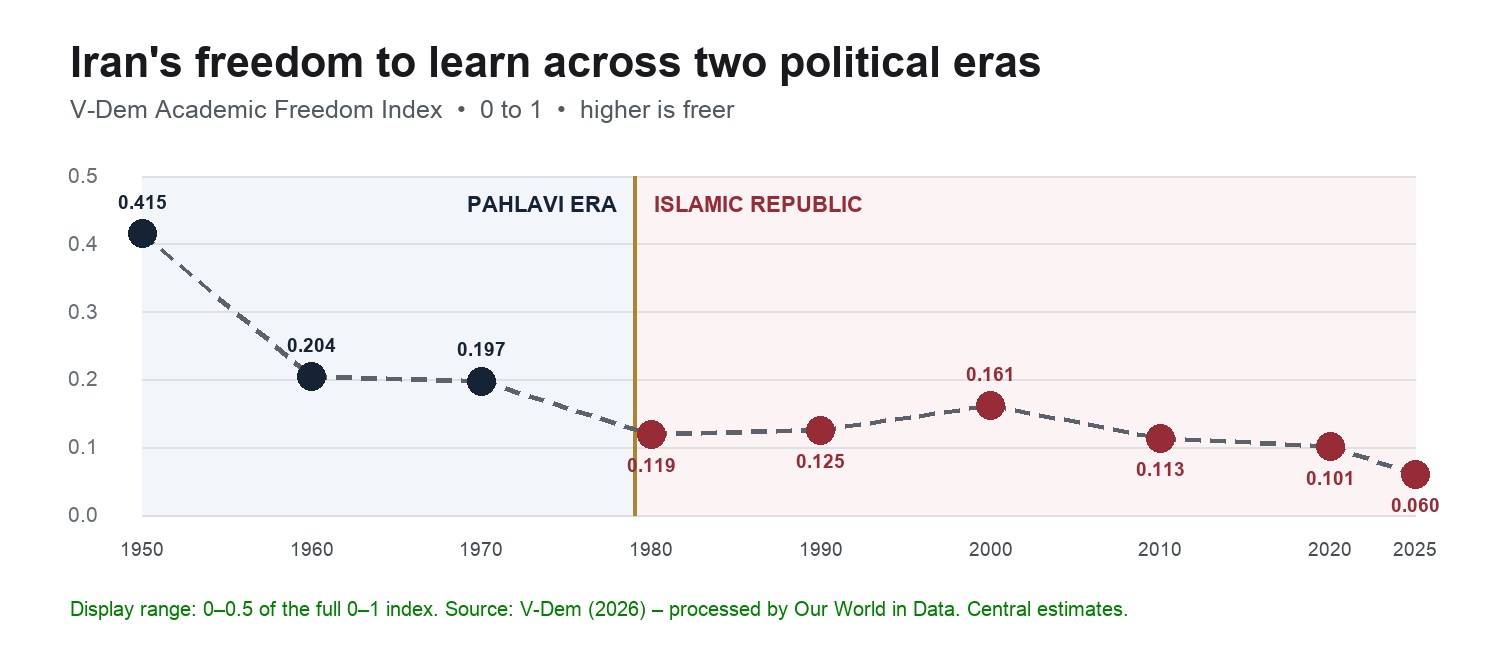
Figure 1. Iran’s Academic Freedom Index at selected dates from 1950 to 2025
V-Dem’s central estimate for Iran declined from 0.415 in 1950 to 0.204 in 1960, but this should not be read as a judgment on the Pahlavi state’s broader educational record. During the same period, the government expanded universities, promoted study abroad and strengthened Iran’s international academic connections. Universities also became important centres of organized political opposition: nationalist and radical left-wing groups, including Marxists, used campuses to challenge the Shah and Iran’s alignment with the West, while recurring protests and confrontations sometimes disrupted ordinary academic life. [26] V-Dem cannot determine how much each actor contributed to the resulting conditions. The post-1979 comparison is nevertheless clear: every Islamic Republic benchmark shown in the figure is lower than every selected Pahlavi-era observation. Even the highest selected post-revolutionary estimate (0.161 in 2000) remained below the lowest Pahlavi benchmark shown (0.197 in 1970). By 2025, the estimate had fallen to just 0.060. [24] [25]
Figure 2 compares academic freedom in Iran with selected regional and international countries in 2025; it does not rank political systems as a whole. Iran records the group’s lowest central estimate, at 0.060. Although uncertainty ranges make the exact order of the lowest-scoring countries less certain, Iran’s position at the extreme low end is clear. [24] [25] This finding is consistent with documented discrimination in university access, ideological screening and pressure on dissenting students and academics. [16] [18] The Islamic Republic has therefore undermined both equal access to higher education and the freedoms essential to academic life. Iraq’s higher score also shows that academic freedom and overall democracy are distinct measures.
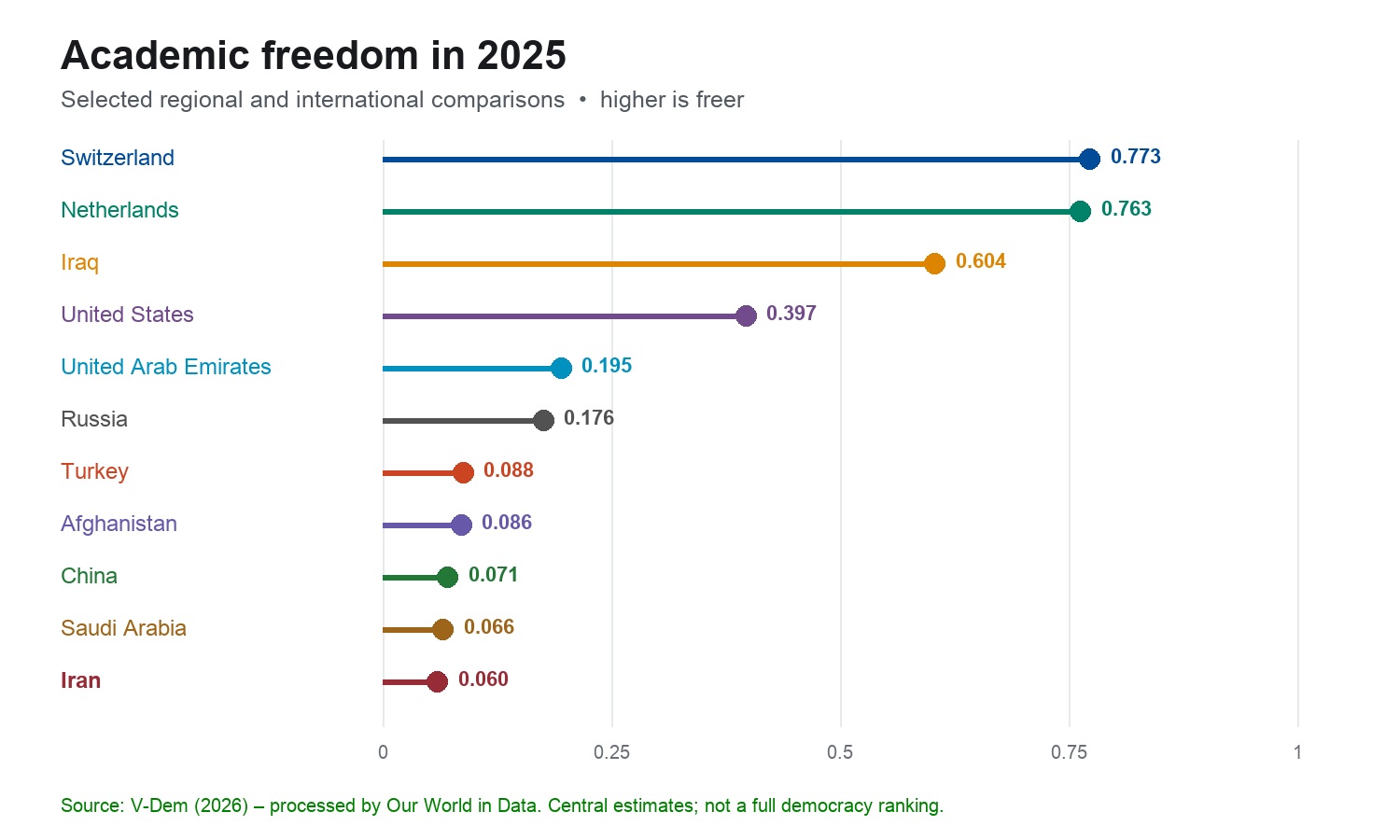
Figure 2. Selected country estimates for 2025 on the same zero-to-one index
5. This sequence in one view
Late Qajar Iran showed that constitutional promises without effective state capacity could not reliably protect citizens. Pahlavi built that capacity and expanded education, women’s formal rights, economic opportunity and Iran’s regional reach. Their constitutional development remained incomplete, but the foundations for further evolution were much stronger than before.
The Islamic Republic retained completely changed Iran’s governing logic. Unelected clerical institutions acquired final authority; secular legal reforms were reversed; and ideological conformity, unequal access and brain drain weakened education’s role as a national development project. Recent protest waves show that the conflict between society and the state remains unresolved, exposing a wide gap between large parts of society and the governing ideology.
Sources
[1] Curtis, Glenn E., and Eric Hooglund, eds. Iran: A Country Study. 5th ed. Washington, DC: Federal Research Division, Library of Congress, 2008.
https://www.loc.gov/item/2008011784/
[2] Amanat, Abbas. “CONSTITUTIONAL REVOLUTION I. INTELLECTUAL BACKGROUND.” Encyclopædia Iranica Online. Published August 10, 2018.
https://www.iranicaonline.org/articles/constitutional-revolution-i/
[3] Arjomand, Saïd Amir. “CONSTITUTIONAL REVOLUTION III. THE CONSTITUTION.” Encyclopædia Iranica Online. Published August 6, 2013.
https://www.iranicaonline.org/articles/constitutional-revolution-iii/
[4] Shambayati, Niloofar. “COUP D’ETAT OF 1299/1921.” Encyclopædia Iranica Online. Published October 26, 2015.
https://www.iranicaonline.org/articles/coup-detat-of-1299-1921/
[5] Afkhami, Amir Arsalan. “INFLUENZA.” Encyclopædia Iranica Online. Published August 21, 2012.
https://www.iranicaonline.org/articles/influenza/
[6] Ashraf, Ahmad. “EDUCATION VII. GENERAL SURVEY OF MODERN EDUCATION.” Encyclopædia Iranica Online. Published January 30, 2017.
https://www.iranicaonline.org/articles/education-vii-general-survey-of-modern-education/
[7] Sheikholeslami, Alireza. “ADMINISTRATION IN IRAN VII. PAHLAVI PERIOD.” Encyclopædia Iranica Online. Published May 29, 2018.
https://www.iranicaonline.org/articles/administration-vii-pahlavi/
[8] Yarshater, Ehsan. “IRAN II. IRANIAN HISTORY (2): ISLAMIC PERIOD (PAGE 6).” Encyclopædia Iranica Online. Published April 1, 2016.
https://www.iranicaonline.org/articles/iran-ii2-islamic-period-page-6/
[9] Inter-Parliamentary Union. “Iran (Islamic Republic of): Historical Data on Women.” Parline. Accessed September 6, 2026.
https://data.ipu.org/parliament/IR/IR-LC01/elections/historical-data-on-women/
[10] Sabahi, Farian. “LITERACY CORPS.” Encyclopædia Iranica Online. Published May 14, 2018.
https://www.iranicaonline.org/articles/literacy-corps-1/
[11] Mir-Hosseini, Ziba. “FAMILY LAW III. IN MODERN PERSIA.” Encyclopædia Iranica Online. Published May 22, 2013.
https://www.iranicaonline.org/articles/family-law-iii-in-modern-persia/
[12] Balslev, Sivan. “Scouting in Iran Amid Changing Practices of Masculinity and Childhood.” The Journal of Imperial and Commonwealth History 52, no. 2 (2024): 326–349.
https://doi.org/10.1080/03086534.2024.2325737
[13] Moezi Moghadam, Fereydoun. “KĀNUN-E PARVAREŠ-E FEKRI-E KUDAKĀN VA NOWJAVĀNĀN.” Encyclopædia Iranica Online. Published October 29, 2012.
https://www.iranicaonline.org/articles/kanun-e-parvares-e-fekri-e-kudakan-va-nowjavanan/
[14] Pesaran, M. Hashem. “ECONOMY IX. IN THE PAHLAVI PERIOD.” Encyclopædia Iranica Online. Published January 16, 2014.
https://www.iranicaonline.org/articles/economy-ix/
[15] Constitution of the Islamic Republic of Iran. 1979, amended 1989. Articles 2, 5, 57, 91, 94, 99, and 110. English translation distributed by the Constitute Project.
https://www.constituteproject.org/constitution/Iran_1989.pdf?lang=en
[16] Freedom House. “Iran: Freedom in the World 2026 Country Report.” Freedom in the World 2026. 2026.
https://freedomhouse.org/country/iran/freedom-world/2026
[17] Mehran, Golnar. “EDUCATION XXIV. EDUCATION IN POSTREVOLUTIONARY PERSIA, 1979–95.” Encyclopædia Iranica Online. Published April 22, 2013.
https://www.iranicaonline.org/articles/education-xxiv-education-in-postrevolutionary-persia-1979-95/
[18] Human Rights Watch. “Iran: Ensure Equal Access to Higher Education.” News release, September 22, 2012.
https://www.hrw.org/news/2012/09/22/iran-ensure-equal-access-higher-education
[19] Human Rights Watch. “The Boot on My Neck”: Iranian Authorities’ Crime of Persecution against Baha’is in Iran. April 1, 2024.
https://www.hrw.org/report/2024/04/01/boot-my-neck/iranian-authorities-crime-persecution-against-bahais-iran
[20] United Nations Human Rights Committee. Concluding Observations on the Fourth Periodic Report of the Islamic Republic of Iran. CCPR/C/IRN/CO/4. November 23, 2023, paras. 57–58.
https://documents.un.org/api/symbol/access?l=en&s=CCPR%2FC%2FIRN%2FCO%2F4&t=pdf
[21] Parviz, Muhammed. “Reflecting on the Consequences of the Iranian University Entrance Examination: A Systematic-Narrative Hybrid Literature Review.” Discover Education 2, article 22 (2023).
https://doi.org/10.1007/s44217-023-00046-x
[22] Azadi, Pooya, Matin Mirramezani, and Mohsen B. Mesgaran. Migration and Brain Drain from Iran. Working Paper 9. Stanford Iran 2040 Project, Stanford University, April 2020.
https://iranian-studies.stanford.edu/publications/migration-and-brain-drain-iran
[23] Coppedge, Michael, et al. “V-Dem Codebook v16.” Varieties of Democracy (V-Dem) Project, 2026.
https://www.v-dem.net/documents/70/codebook_v16.pdf
[24] Coppedge, Michael, et al. “V-Dem Country-Year Dataset v16.” Varieties of Democracy (V-Dem) Project, 2026.
https://doi.org/10.23696/vdemds26
[25] V-Dem (2026), processed by Our World in Data. “Academic freedom index – V-Dem” [dataset]. V-Dem, Democracy report v16 [original data]. Retrieved September 6, 2026; archived August 6, 2026.
https://archive.ourworldindata.org/20260806-091206/grapher/academic-freedom-index.html
[26] Foreign Relations of the United States, 1969–1976, Volume E–4, Documents on Iran and Iraq, 1969–1972. Edited by Monica L. Belmonte. Washington, DC: Government Printing Office, 2006. Document 84, attachment “Student Unrest Abroad” (Central Intelligence Agency, August 1970).
https://history.state.gov/historicaldocuments/frus1969-76ve04/d84