
The Book of Esther is one of the best-known stories in the Bible, yet its deep connection to ancient Iran is often overlooked. Set in Susa (Shush) during the Achaemenid period, the story presents a vivid world of kingship, royal decrees, written laws, court officials, messengers, and provinces. This article explores the historical setting of Esther, a Jewish queen, and the Persian world in which her story unfolds, from the origins of Purim to the mausoleum in present-day Hamadan, identified as the tomb of Esther and Mordecai. Through this historical and cultural lens, Esther offers a fascinating connection between biblical memory, Iranian history, and cultural heritage.
By Ashian A.
Special thanks to Lucinda W.
The Biblical Story
For millions of Jews and Christians around the world, Esther and Mordecai are familiar and beloved figures from the Bible [1]. Their story has been read, studied, and celebrated for centuries.
At the heart of the Book of Esther is the remarkable story of a young, secretly Jewish woman who entered the royal court of the Iranian King Ahasuerus (commonly referred to as Xerxes I)(1) and became his queen. As the story unfolds, the king elevates a man from Amalekite, named Haman, to a position above the other officials of the kingdom. The king even gives Haman his signet ring, granting him the authority to issue decrees in the king’s name. Haman’s pride, however, is wounded when Mordecai, Esther’s cousin, refuses to bow before him. Mordecai’s refusal is questioned by those around him, and he identifies himself as a Jew. Haman becomes enraged and, upon learning that Mordecai is Jewish, decides not merely to punish him but to destroy the entire Jewish population throughout the Persian kingdom.
Mordecai becomes aware of the deadly plot and urges Esther to use her extraordinary position beside the king to intervene. At great personal risk, Esther reveals both her Jewish identity and Haman’s scheme to the king. The plot is ultimately exposed and defeated, and Haman himself is executed on the gallows he had prepared for Mordecai. Through Mordecai’s courage and Esther’s intervention, the Jewish population across the kingdom is spared from the dreadful fate that had been intended for them.
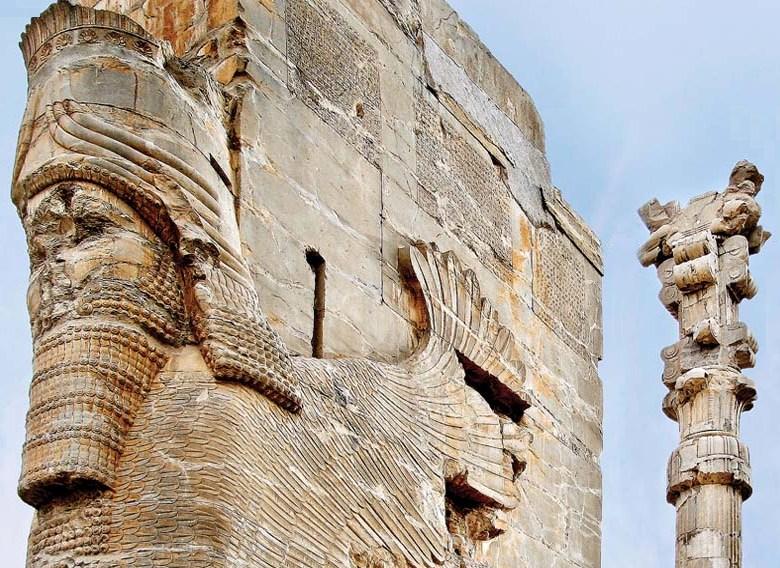
Inscription of the Gate of All Nations at Persepolis, Iran, commissioned by Xerxes I and written in Old Persian, Elamite, and Babylonian. Source: Wikimedia
What is less widely known is that the story of Esther takes place in ancient Iran. The royal court described in the Book of Esther was located in Susa(2), one of the great cities of the Achaemenid(3) era. The king, the royal officials, the laws, the messengers, and the events described throughout the book are all connected to the world of ancient Iran.
At the same time, many Iranians are surprised to learn that one of the most famous books of the Bible is closely connected to their own history and cultural heritage. Likewise, many readers of the Bible are unaware that, according to a long-standing tradition, the Tomb of Esther and Mordecai is located in current Hamadan, Iran.
This article invites readers to look at ancient Iran through the story of Esther. By exploring the historical setting of the Book of Esther, we can better understand not only the biblical narrative itself, but also the remarkable connection between Iran and one of the most widely known stories in the Bible.
Ancient Iran in the Book of Esther
The Book of Esther opens with a striking image of ancient Iran under King Ahasuerus, whose kingdom extended from India to Ethiopia and included 127 provinces. In the third year of his reign, the king gathered officials, military leaders, nobles, and provincial authorities at Susa and displayed the wealth and splendor of his kingdom for 180 days. This was followed by a seven-day banquet at the royal palace. The detailed description of marble pillars, silver rings, couches of gold and silver, precious stones, and golden vessels offers a vivid glimpse into the magnificence and ceremonial life of the royal court (Esther 1:1–7).
Yet perhaps the most remarkable picture of ancient Iran in Esther is not its wealth and beauty, but its system of government. Throughout the book we encounter laws, royal advisers, satraps, governors, scribes, written decrees, official seals, couriers, and royal records. The king is described as consulting men knowledgeable in “law and legal matters” before a royal decision is written into law (Esther 1:13–22). When decrees are later issued, they are written for each province in its own script and for each people in their own language, sealed with the king’s signet ring, and carried throughout the kingdom by royal couriers (Esther 3:12–15).
This biblical description is particularly interesting when placed beside historical scholarship on Achaemenid Iran. Matt Waters, in Ancient Persia: A Concise History of the Achaemenid Empire, 550–330 BCE [2], describes the royal court, satrapal administration, provincial government, and communication networks that enabled the Achaemenid monarchy to govern an enormous and culturally diverse territory. Studies of Achaemenid law likewise provide independent evidence for organized legal and judicial practices [4]. The administrative world portrayed in Esther therefore has significant points of contact with what is known historically about Achaemenid government.
The importance of written law becomes central when queen Esther reveals Haman’s plan to destroy the Jewish population. Although Haman is exposed, the earlier decree remains in force. Esther asks that the letters be revoked, but the king explains that a decree issued in the king’s name and sealed with his signet ring (in the hands of Haman) cannot be revoked. Instead, Esther and Mordecai are authorized to issue another royal decree. The scribes are summoned again, and the new order is sent to all 127 provinces, in their different scripts and languages, granting the Jews the legal right to assemble and defend themselves (Esther 8:3–14). The text even identifies the mounted messengers as using the royal mail relay horses.
The story also offers a glimpse of royal honor. Mordecai had previously uncovered a plot against the life of King Ahasuerus by Bigtan and Teresh, an act recorded in the royal chronicles. When the king later discovers that Mordecai was never rewarded, he orders him to be dressed in a royal robe, placed upon the king’s own horse, and led publicly through the city by Haman (Esther 2:21–23; 6:1–11). After Haman’s plot is exposed and he is executed, the king gives Mordecai the royal signet ring that had previously belonged to Haman, while Haman’s estate is given to Esther. Mordecai is subsequently elevated to a position of great authority at the royal court (Esther 8:1–2).
The biblical relationship between the Jewish people and ancient Iran extends beyond Esther. In the Book of Nehemiah, Artaxerxes I(4) later grants Nehemiah permission and royal letters to travel to Jerusalem and assist in rebuilding its walls (Nehemiah 2:1–8). These accounts place Iranian kings repeatedly within important moments of Jewish history.
Seven (Haft) in Iranian Culture: From Ancient Tradition to the Present
One final cultural detail may be especially meaningful to readers unfamiliar with Iranian traditions: the remarkable place of the number seven (7) in Iranian culture. The Book of Esther repeatedly draws attention to this number, a seven-day royal banquet, seven leading officials of Persia and Media, seven attendants chosen for Esther, and Esther’s arrival at the royal palace in the seventh year of the king’s reign. This repetition becomes particularly interesting when viewed alongside the deep and enduring significance of seven in Iranian religious and cultural traditions.
In Zoroastrian thought, a sacred group of seven, Ahura Mazda together with the six Amesha Spentas is associated with fundamental ethical ideals such as Good Thought, Truth and Righteousness, Desirable Dominion, Devotion, Wholeness, and Immortality, as well as with the seven creations [3]. In a later Zoroastrian tradition, Zarathustra is described as seeing a tree with seven metallic branches, representing successive ages in a vision concerning the future.
The number seven continued to appear throughout Iranian cultural memory: Ferdowsi’s Shahnameh, Iran’s great national epic, contains the famous Haft Khan-e Rostam, or Seven Labors of Rostam; Iranian tradition speaks of the Haft Keshvar, or Seven Regions; and the celebration of Nowruz is today closely associated with the familiar Haft-Sin table. The word Haft (“seven”) also survives in numerous Iranian place names, including Haft Tappe (“Seven Mounds”), the ancient site near Susa (Sush), and Haft Cheshmeh (“Seven Springs”), a name found in different parts of Iran.
The recurrence of seven can even be observed in much later Iranian royal and military symbolism; for example, the Pahlavi-era Imperial Iranian military emblem displays symmetrical leafy branches surrounding the Lion and Sun, with seven leaves visible on each side.
.svg.webp)
Imperial Emblem of the Pahlavi Dynasty, with seven leaves on each side. Source: Wikimedia.
The presence of seven across such widely separated periods does not mean that every example necessarily shares the same origin or meaning. Nevertheless, its remarkable recurrence across Iranian religion, ethical thought, literature, geography, celebrations, royal symbolism, and the Book of Esther itself offers a fascinating cultural parallel and invites the reader to view this familiar biblical number through an Iranian cultural lens.
A Living Legacy: Purim, Esther, and Iran
The legacy of Esther reaches far beyond the ancient court of Susa. According to the Book of Esther, the deliverance of the Jewish people became the foundation of Purim, a festival named after the Hebrew word pur, meaning “lot.” Haman cast lots, using an ancient method of chance similar in principle to rolling dice, to determine the date for his planned destruction of the Jewish people. Purim was then established as an annual celebration of joy and feasting, with people sharing food and giving gifts to the poor (Esther 3:7; 9:20–32). Jewish communities around the world continue to celebrate Purim today, keeping alive the memory of events that the Book of Esther places in ancient Iran under King Ahasuerus.
Yet the story is remembered not only in the pages of the Bible or through the celebration of Purim. In Hamadan, the ancient Ecbatana and one of the great royal centers of ancient Iran, there is a Mausoleum for Esther and Mordecai. For generations, the site has been revered as a sacred place and visited by Jews and Christians, giving this ancient story a physical presence in Iran even today.
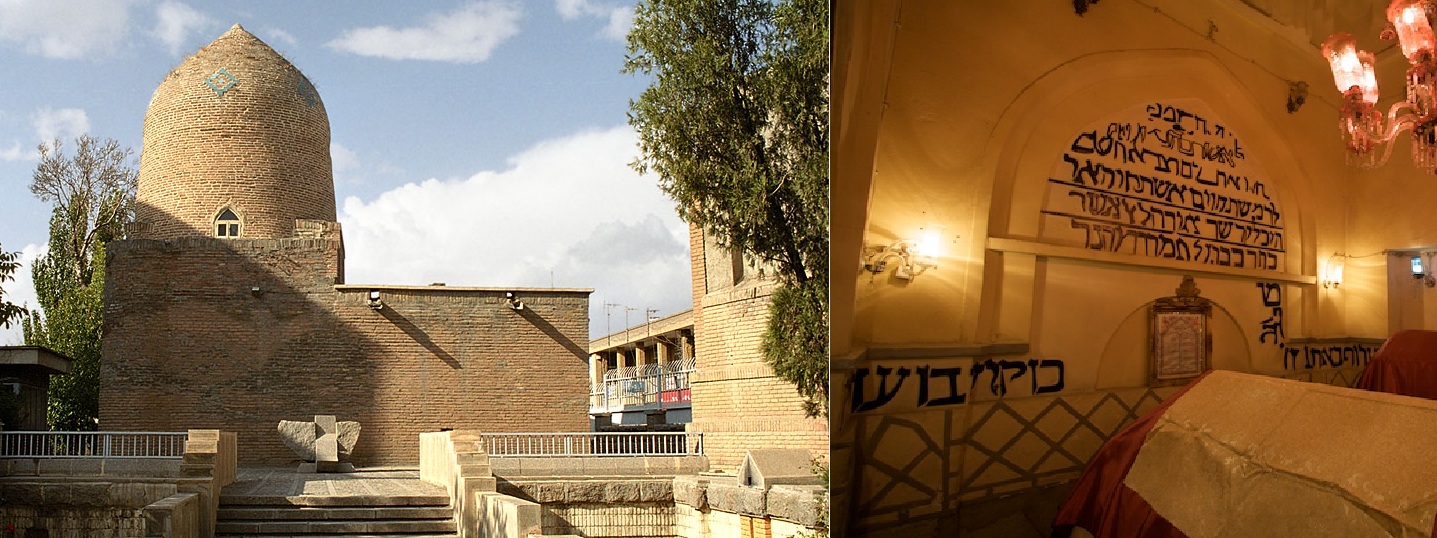
Mausoleum of Esther and Mordechai, Hamadan, Iran. Source: Wikimedia.
Kingdoms have risen and fallen, dynasties have come and gone, and the world around it has changed beyond recognition; yet the names of Esther and Mordecai remain in Iran. Their story continues to be told, Purim continues to be celebrated, and their traditional resting place in Hamadan continues to preserve the memory of an extraordinary bond between Iranian and Jewish history. Perhaps this is the most beautiful legacy of the Book of Esther: that a story set in the royal courts of ancient Iran still lives today, in faith, in memory, in celebration, and in the heart of Iran itself.
(1) Most commonly referred to as Xerxes I, known in Persian as Khashayarshah, ruled from 486 to 465 BCE. He was a grandson of Cyrus the Great; “Shah” means “king” in Persian. Historical records cite the wife of Xerxes I as Amestris and not Esther as written in biblical records. Some scholars identify Ahasuerus in this biblical story as Artaxerxes I (son of Xerxes I), or Artaxerxes II (great-grandson of Xerxes I).
(2) Susa (Shush in Persian) was one of the principal royal cities and administrative centers of the Achaemenid monarchy, located in present-day Khuzestan Province in southwestern Iran.
(3) The Achaemenids (Hakhamaneshiyan in Persian) were the Iranian royal dynasty that ruled from approximately 550 to 330 BCE, beginning with Cyrus the Great.
(4) Artaxerxes I (Ardeshir I), son of Xerxes I, ruled from 465 to 424 BCE.
References
[1] Amplified Bible (AMP). Copyright © 2015 by The Lockman Foundation.
[2] Waters, Matt. Ancient Persia: A Concise History of the Achaemenid Empire, 550–330 BCE. Cambridge University Press, 2014.
[3] Modi, Jivanji Jamshedji. The Religious Ceremonies and Customs of the Parsees. Bombay: British India Press, 1922.
[4] Magdalene, F. Rachel. “Judicial and Legal Systems i. Achaemenid Judicial and Legal Systems.” Encyclopaedia Iranica, Vol. XV, Fasc. 2, pp. 174–177, 2009; updated 2018.